Inrunner Motor with Tangential Magnets Polarization vs Outrunner with Radial Magnets Polarization
A simulation-based analysis demonstrating how tangential magnet polarization in inrunner motors achieves significantly greater torque performance compared to outrunner designs with radial polarization.
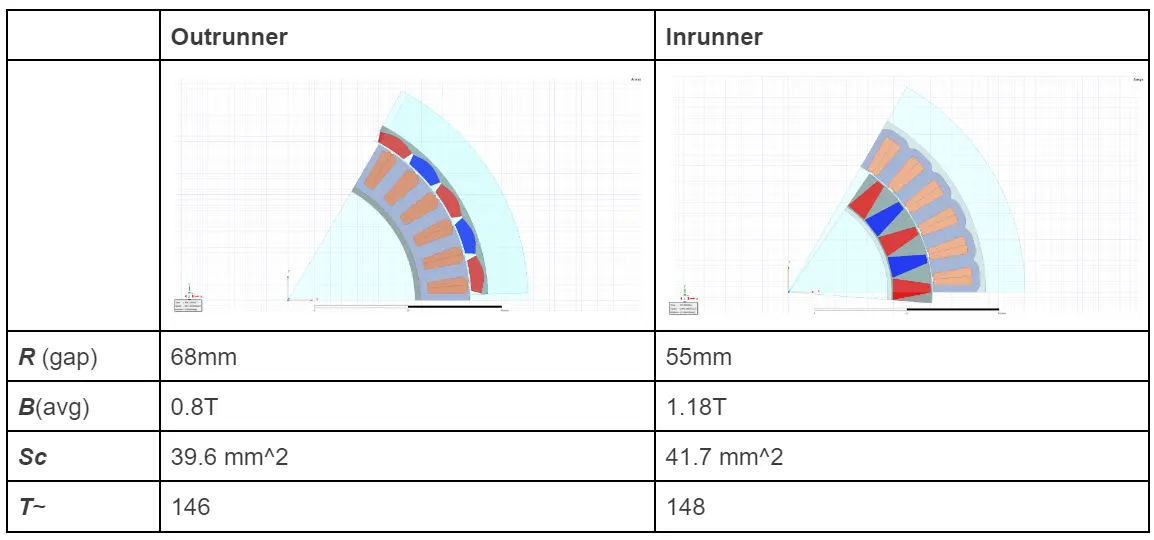
Torque Equation in Synchronous Motors
The torque in a synchronous motor or generator is directly proportional to the stator field strength, rotor field strength, and the sine of the angle between them — as well as the area of the gap between the stator and the rotor.
This simplifies to the fundamental torque equation:
Te ~ R × R × Sc × B
For motors with identical diameter, length, mass, and current density, the equation reduces to show that magnetic field strength (B) and coil cross-section are the primary differentiators between motor designs.
Magnetic Field at Air Gap — Outrunner Motor
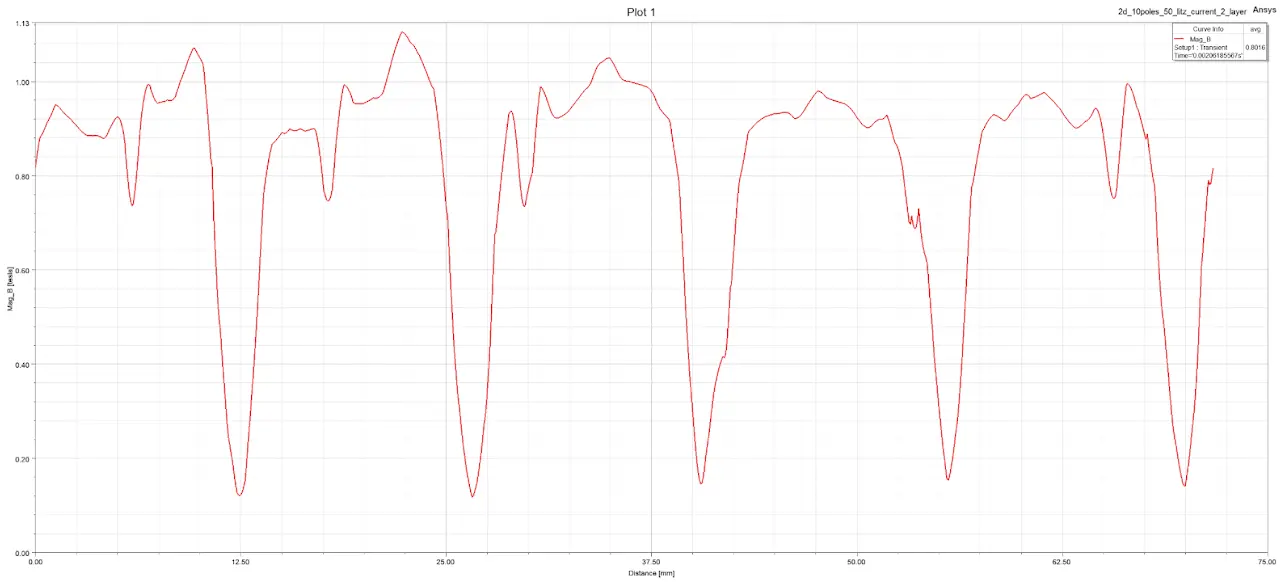
In a conventional outrunner motor with radial magnet polarization, the magnetic field at the air gap is limited by the geometry of the radial magnet arrangement. The magnets are polarized perpendicular to the rotor surface, and the resulting flux density in the air gap is constrained by the magnet grade and volume.
Additionally, outrunner configurations typically require larger air gaps and have structural limitations that reduce the effective magnetic field reaching the stator windings.
Magnetic Field at Air Gap — Inrunner Motor
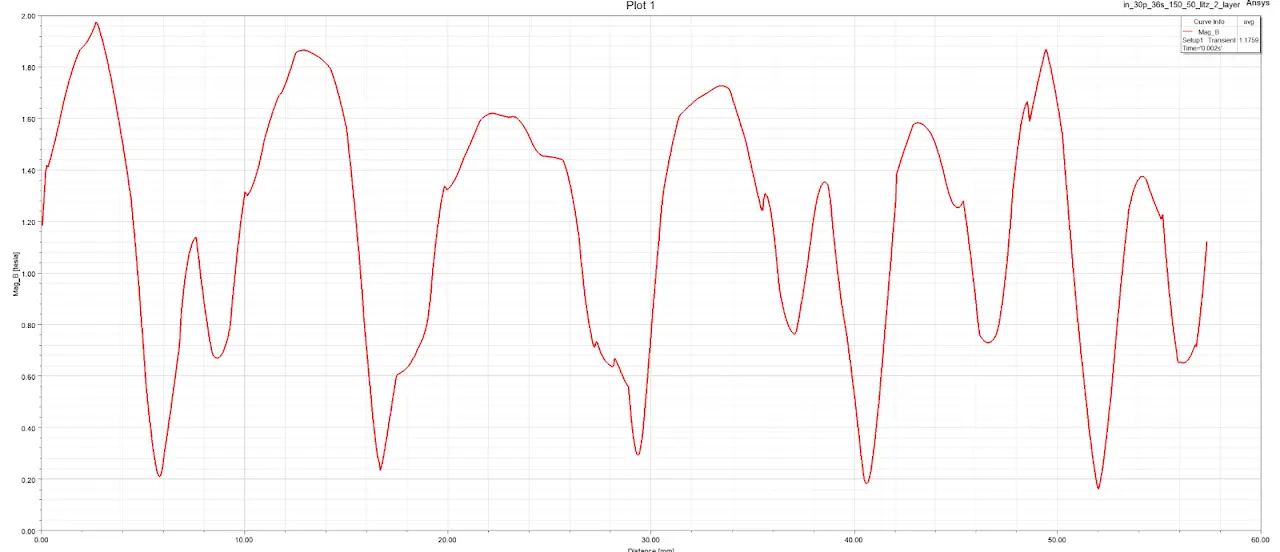
The inrunner configuration with tangential magnet polarization achieves a fundamentally different magnetic circuit. Magnets are polarized tangentially (along the direction of rotation), creating a flux concentration effect between adjacent magnets.
Key advantage:
The tangential magnetic array construction for inrunner motors can increase magnetic field strength by up to 1.5× compared to standard radial magnet construction — for motors of equal size, weight and current density.
This improvement comes from the Halbach-like flux concentration between tangentially polarized magnets. The concentrated field effectively increases B in the torque equation, directly multiplying output torque without increasing motor size or weight.
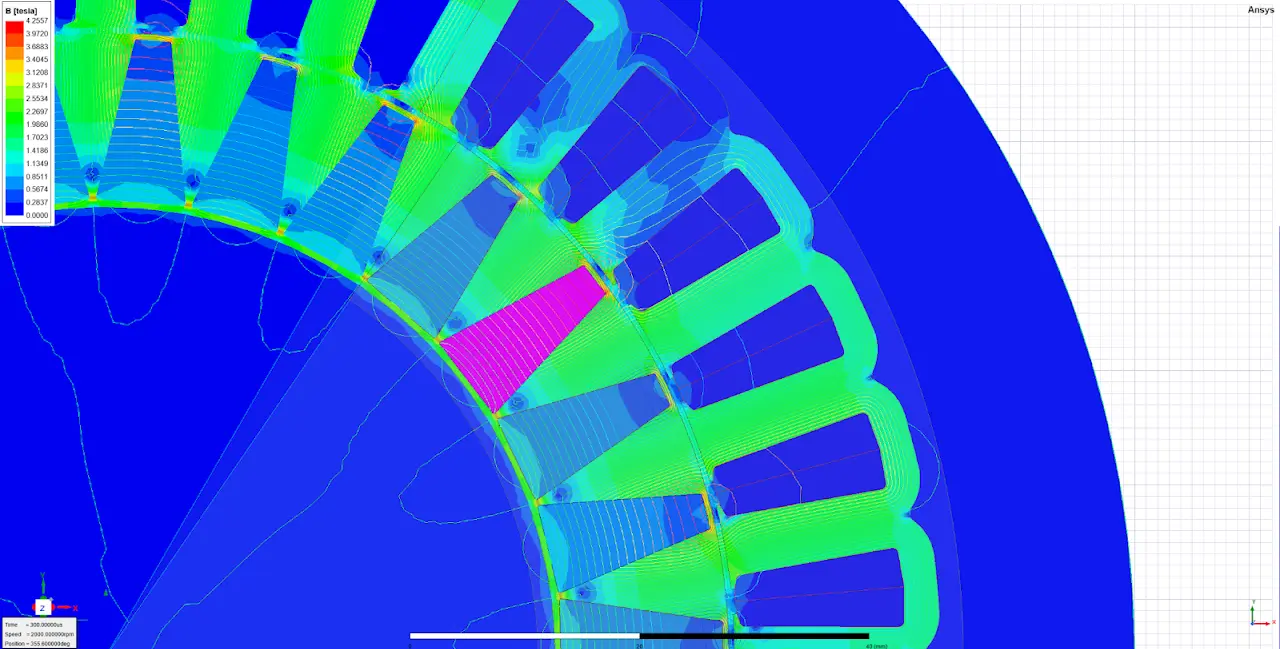
Simulation Results
Simulation data comparing two motors with identical specifications:
| Parameter | Outrunner (Radial) | Inrunner (Tangential) |
|---|---|---|
| Diameter | 150 mm | 150 mm |
| Weight | 5.4 kg | 5.4 kg |
| Magnet polarization | Radial | Tangential |
| Air gap field (B) | 1.0× | up to 1.5× |
| Torque output | Baseline | +30–50% higher |
Conclusion
The simulation results confirm that inrunner motors with tangential magnet polarization deliver significantly greater torque than outrunner designs of the same size and weight. This is the core technology behind eMotres patented motor construction.
Combined with grain-oriented steel stator cores, rectangular copper windings, and direct stator cooling, eMotres motors achieve the highest torque density available on the market — surpassing both conventional radial outrunners and axial flux motors.